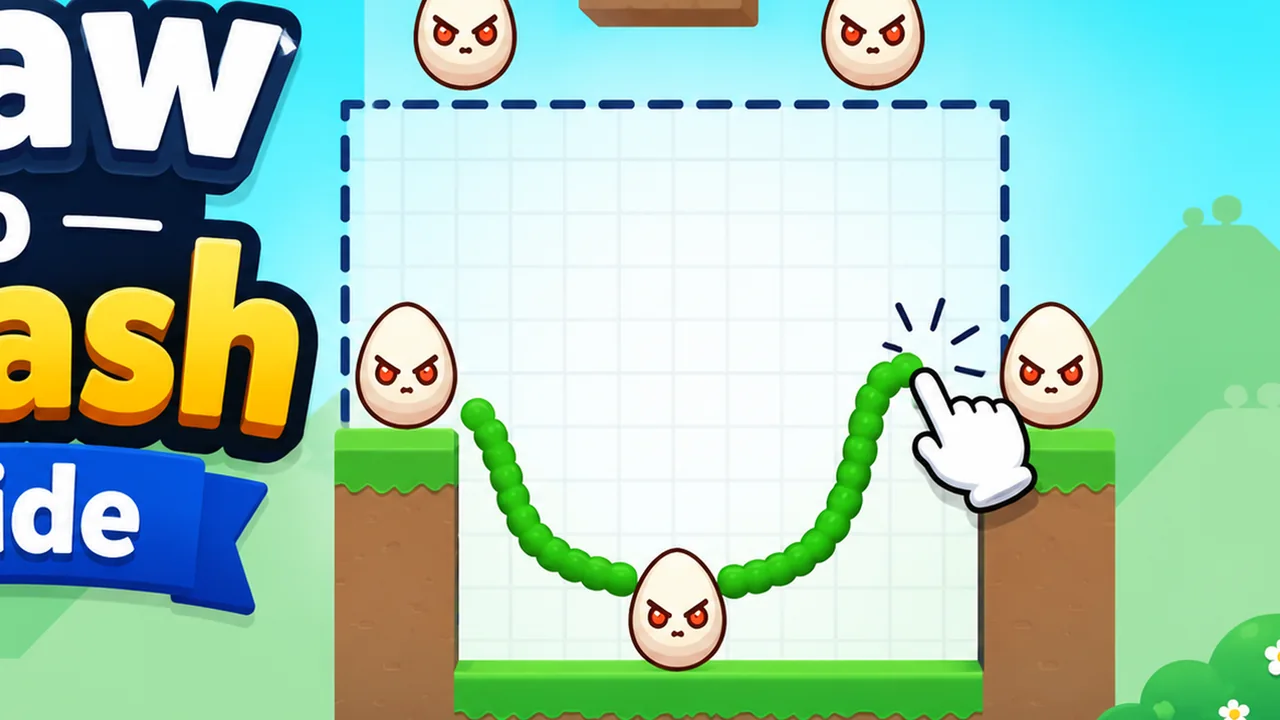
This is an independent strategy article for a drawing-and-physics puzzle experience. Exact layouts can vary, so focus on the underlying ideas rather than copying one fixed line.
Draw To Smash rewards a useful combination of observation, creative drawing, and physics prediction. The most reliable players do not simply draw more ink. They identify the first contact point, understand which side of a shape is heavier, and choose a stroke that has a clear job. This article focuses on practical techniques you can repeat across many puzzle layouts.
Minimum-Ink Challenge
Complete a level with the shortest possible stroke. This pushes you to focus on placement and efficient contact rather than large safety shapes.
Apply this idea by first testing a simple version of the shape. Watch the exact moment it touches a surface, then make one controlled adjustment. This keeps your next attempt measurable instead of random.
One-Shape Rule
Choose one shape family, such as bars or loops, and use it for several levels. You will learn the strengths and limitations of that shape very quickly.
Apply this idea by first testing a simple version of the shape. Watch the exact moment it touches a surface, then make one controlled adjustment. This keeps your next attempt measurable instead of random.
No-Reset Run
Play a sequence of levels without restarting after a poor result. The rule encourages careful planning and makes each decision feel more meaningful.
Apply this idea by first testing a simple version of the shape. Watch the exact moment it touches a surface, then make one controlled adjustment. This keeps your next attempt measurable instead of random.
Prediction Challenge
Before releasing the stroke, say or write where you expect the shape to land and which direction it will rotate. Compare your prediction with the result.
Apply this idea by first testing a simple version of the shape. Watch the exact moment it touches a surface, then make one controlled adjustment. This keeps your next attempt measurable instead of random.
Personal Best Board
Track the number of attempts or strokes used on each level. Try to improve your own record rather than copying a single solution. This keeps the puzzle creative and replayable.
Apply this idea by first testing a simple version of the shape. Watch the exact moment it touches a surface, then make one controlled adjustment. This keeps your next attempt measurable instead of random.
Putting the Method Together
Before every attempt, pause and describe the solution in one sentence. For example: “I need a wide bar that lands level,” or “I need a heavy right side that rotates from the platform edge.” A clear sentence helps you remove unnecessary parts from the drawing.
After release, study the first second of movement. Did the shape rotate too early? Did it hit an obstacle before the intended platform? Did the contact occur above or below the target? The answer tells you what to change. Move the same shape slightly when the overall concept is sound. Change the shape family when the motion itself is wrong.
Quick Checklist
- Identify every target and protected area.
- Choose the first surface your drawing should touch.
- Use the smallest shape that can do the job.
- Control balance by adding or removing weight from one side.
- Adjust one variable at a time after a miss.
Final Thoughts
The strongest Draw To Smash solutions usually look intentional rather than complicated. A clean bar, compact loop, controlled wedge, or balanced hook can outperform a large scribble because its movement is easier to predict. Use each failure as physics feedback, and your solutions will become faster, cleaner, and more creative.